From call to loaded
Six steps, and youknow the price at step two
No part of this is a mystery, so none of it is hidden. This is exactly what happens between you dialling the number and your vehicle arriving where it needs to be.
Skip to the front
Reading this while stood next to the car? Do not. Step one is a phone call and it takes under a minute.
- 01
You call, we answer
Under 60 secondsA person picks up, not a queue. Usually the person who will send the truck.
We ask four things: where you are, what the vehicle is, what has happened, and where it needs to end up. That is enough to price the job and pick a truck. If you are somewhere dangerous, say so first — it changes what we do next and how fast we move.
- Your location: a postcode, junction number or motorway marker post
- The vehicle: make, colour and registration if you have it
- The fault: what it is doing, or what happened
- The destination: your garage, your home, or our yard
- 02
Fixed price, agreed before we move
On the same callA single number covering the call-out, the recovery and the drop-off.
We quote before the truck leaves, and the quote does not move unless the job turns out to be genuinely different from what was described — a vehicle in a ditch rather than on a driveway, for example. If that happens we ring you and agree the change before doing anything, not after.
- One figure, not an hourly meter
- No call-out fee bolted on top
- VAT position made clear at the time of quoting
- Any change to scope agreed with you first
- 03
Nearest truck dispatched
Typically 10–45 minYou get a realistic ETA and the driver's details, then updates if anything slips.
We give you the arrival time we actually believe, not the one that sounds best. If traffic turns against us, you get a call — being told the truth at minute ten is worth more than a cheerful estimate that quietly expires. Live carriageway jobs jump the queue.
- Honest ETA, revised by phone if it changes
- Driver name and vehicle so you know who is arriving
- Live carriageway and hard shoulder jobs prioritised
- We will tell you if we cannot help quickly, so you can call elsewhere
- 04
Roadside fix attempted first
5–20 min on sceneIf it can be sorted where it stands, that is cheaper and faster for you.
Plenty of jobs never need a tow. A jump start, a wheel change, a fuel drop or a fuse can put you back on the road in minutes. We try that first where it is realistic and safe. What we will not do is a bodged fix that strands you again ten miles later — if the battery is dead, we will say so.
- Battery and charging system tested, not just jumped
- Spare or space-saver fitted where you have one
- Locking and seized wheel nuts dealt with
- No offside wheel changes on a live carriageway — we recover instead
- 05
Loaded on the bed
10–15 minWinched or driven onto the flatbed and strapped down properly.
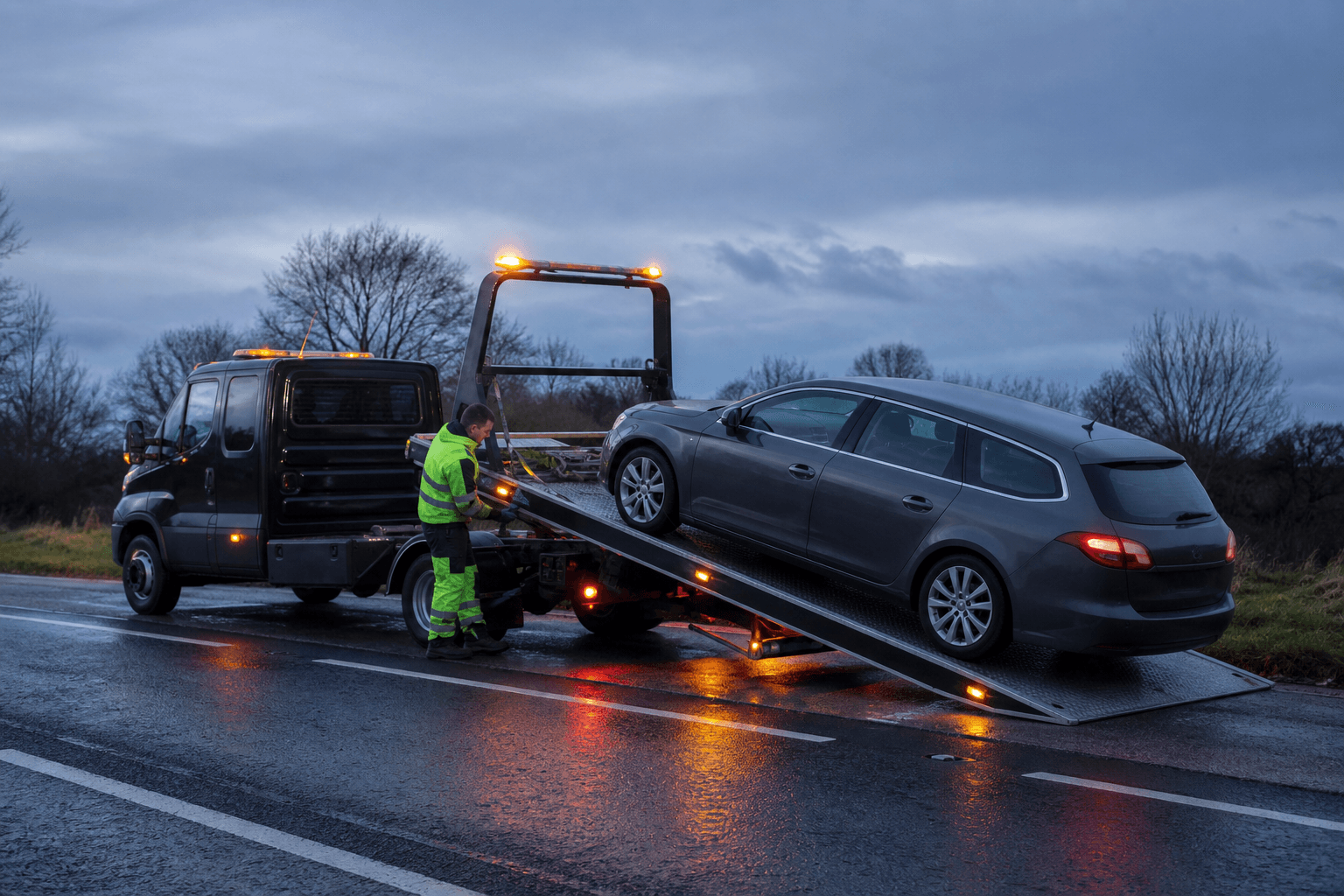
The vehicle is lifted clear of the road, so nothing in the drivetrain turns in transit. Non-runners and locked wheels come on by winch and skates. Straps go over the wheels rather than round suspension components, and we photograph the vehicle before and after loading so its condition is documented.
- Flatbed, so automatics, 4x4s and EVs travel safely
- Winch and skates for non-runners and locked wheels
- Wheel straps, not chassis or suspension straps
- Condition photographed before and after loading
- 06
Delivered and paid
On completionDropped where you asked, paid when the job is done.
We unload at your garage, your driveway or our secure yard. If the destination is closed, we can hold the vehicle overnight and deliver when they open. Payment is on completion by card, cash or bank transfer, and you get a receipt with the job reference on it.
- Delivered to your garage, home or our yard
- Out-of-hours drops held securely until the garage opens
- Card, cash or bank transfer on completion
- Receipt issued with the job reference
Have this ready
Five things thatshorten the call
None of it is essential — ring first and work it out with us if you are stuck. But having these to hand turns a five-minute call into a ninety-second one.
- Your location — postcode, junction number or motorway marker post
- The registration, make and colour of the vehicle
- What happened, and whether the vehicle still rolls and steers
- Where it needs to end up — garage, home, or our yard
- Whether anyone is waiting with the vehicle, and whether there are children or animals
On a motorway or dual carriageway, safety comes before all of it — read what to do first.
The awkward questions
What if it does not go to plan?
Recovery work rarely runs exactly to the script. Here is how we handle the situations that come up most.
What if the roadside fix does not hold?
Then we recover you, and there is no second call-out charge for it. The attempt is part of the same job — we would rather try the cheap fix and fail than tow a car that only needed a jump.
What if my garage is shut when we get there?
We hold the vehicle securely overnight and deliver it when they open, at no extra charge for the storage. Tell us on the call if you think that is likely so we can plan the run.
What if the job is harder than I described?
We ring you before doing anything. A car described as being on a driveway that turns out to be in a ditch is genuinely a different job, and we will tell you the new figure and let you decide. What we will not do is start work and present a bill afterwards.
What if I am not with the vehicle?
That is fine and quite common — keys left with a neighbour, a car at a garage, a vehicle bought online. We just need to agree access and how the keys change hands before we set off.
What if I need to cancel?
Ring as soon as you know. If the truck has not left there is nothing to pay. If we are already en route, we will tell you honestly where we are and what, if anything, is owed for the run.
Can you deal with my insurer directly?
Yes, for accident recovery. We can invoice the insurer or their appointed repairer and deliver the vehicle straight to the approved bodyshop. You will need to give us the claim reference.
Something else on your mind? Read the full FAQ or ring 07440 702667.
Step one takes under a minute
Where you are, what the vehicle is, what happened, and where it needs to go. That is the whole call.